







 Sustainability
Policy 2010, to recycle | reduce
waste | raise awarenss.
Sustainability
Policy 2010, to recycle | reduce
waste | raise awarenss.
Re-use of existing paths
and tracks:
The East Highland Way was formulated by utilising existing paths and
tracks with an aim of
connecting Scotland’s existing popular long distance walking routes
– forming a complete path
network stretching the length and breadth of the country. By using the
existing stock of rights of
way, drove roads, sheep trails, forestry plantation fire roads, loch-side
trails, estate tracks, minor
roads and woodland trails, the route requires no maintenance and is
self sustaining.
Guidebooks printed by Bell & Bain, Scotland:
http://www.bell-bain.com/environmental.php
"Bell & Bain is one of the oldest established printing companies in Glasgow. Founded in
1831, we have been at the forefront of printing in Scotland for over 180 years.
We specialise in the printing and binding of business, educational, scientific, medical
and technical books and learned journals.
We recognise that our manufacturing operations can generate environmental impacts to
land, air and water and create general and special waste streams and we will take all
reasonable steps to minimise that impact, while still keeping sight of our business
objectives.
The Company will ensure the availability of Environmental information and that the
dissemination of information is processed through briefing, instruction, training and
supervision for all our employees.
To achieve our company objectives the Directors of Bell & Bain will make available all
necessary financial and physical resources and will take collective responsibility
toward being an Environmentally Friendly Company.
Our commitment to the environment includes continually improving our performance,
preventing pollution wherever possible and complying with all applicable laws,
regulations and industry standards.
The Managing Director of Bell & Bain Limited, having regard to the overall operation and
business objectives, has determined that as a matter of policy, the company’s
environmental management system will be based on the requirements of the Environmental
Management System Standard ISO 14001:2004.
This Policy has been communicated to all Bell & Bain Limited staff in order that it may
be understood and readily implemented. Additionally, and to ensure its continued
suitability and effectiveness, the Policy will be subject to ongoing review by the
company Executive at the formal Management Review Meeting."
Raise
awareness of Scotland’s sensitive habitats and rare species:
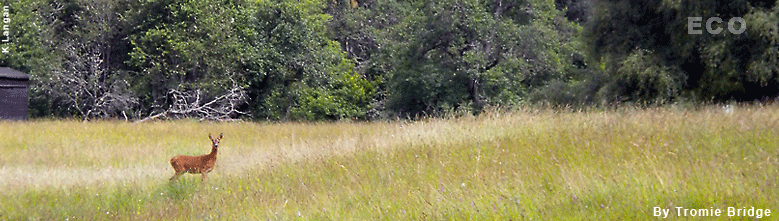
The route passes through some of Scotland’s most sensitive habitats
of European importance.
Between Kingussie and Aviemore, the way passes through some of the most
pristine ancient
wetlands and pine forest harbouring some of our more sensitive species.
From Crossbill to Crested
tit, Wildcat to Pine Martin, the East Highland Way can hopefully help
raise awareness of these rare
species in an effort to learn from, protect and conserve them.
